

E-commerce has matured. Discounts have not.
Most Shopify stores still run promotions as if every buyer is the same — identical coupons, flat percentages, and broad holiday offers that ignore customer behavior, order patterns, buyer types, and profitability.
But here’s the reality:
B2B buyers ≠ Wholesale buyers ≠ VIPs ≠ Retail customers.
If your pricing strategy does not reflect these differences, you’ll end up with one of two problems:
- You discount too aggressively, losing margin you didn’t need to lose, or
- You discount too little, losing loyalty and repeat orders.
The solution sits at the intersection of two modern strategies:
Customer Segmentation + Campaign-Based Discounting
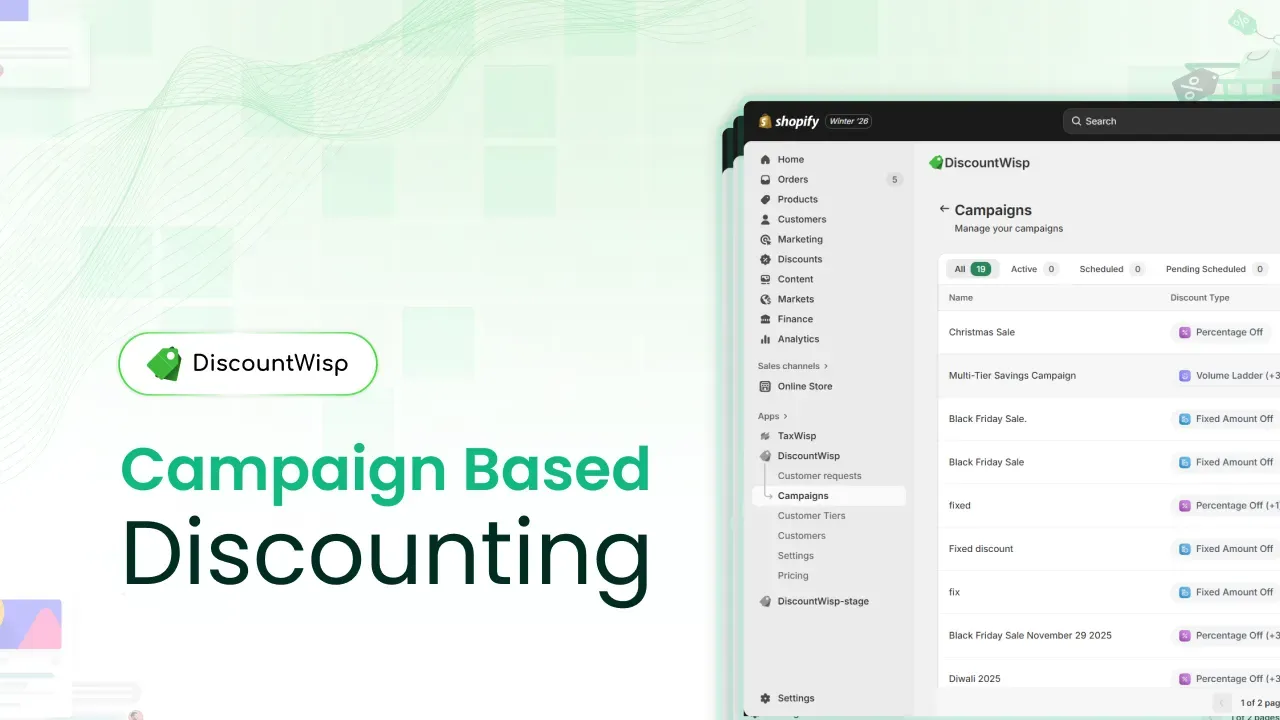
Campaign-based Discounting & Customer Segmentation with DiscountWisp
1. The Problem With “One-Size-Fits-All” Discounting
When stores run generalized promotions (e.g., “Black Friday 20% Off All Products”), they assume:
- Everyone wants the same discount
- Everyone buys for the same reason
- Everyone responds the same way
But ask yourself:
- Does a VIP retail buyer who buys once a month behave like a B2B distributor who buys pallets quarterly?
- Does a loyal repeat customer need the same incentive as a first-time visitor?
Generalized discounting ignores:
- Purchase frequency
- Order volume
- Customer lifetime value (LTV)
- Margin impact
- Segment-specific motivations
This is why most discounting fails — not because discounts don’t work, but because they’re not aligned with customer type.
2. Customer Segmentation Defined (For Shopify Stores)
Customer segmentation is simply the process of grouping customers based on shared traits, such as:
By Buyer Type:
- B2B
- Wholesale
- Retail / D2C
- VIP
- Loyal
- New customer
By Buying Behavior:
- Order volume (units)
- Order frequency
- Seasonal vs routine buyers
- Product affinity
By Value:
- High LTV vs low LTV
- High margin vs low margin
- High repeat vs one-time buyers
Once you understand these segments, the question becomes:
Should every segment get the same discount? Obviously — no.
3. Why Customer Segmentation Matters for Discount Strategy
Here’s what segmented discounting unlocks:
A. Higher Profitability
Wholesale buyers may need MOQ or volume discounts. VIP retail customers may only need occasional fixed-amount incentives.
Different segments need different incentives to convert.
B. Better Retention
Loyalty is built when customers feel recognized. Segmented pricing does that.
C. Cleaner Data + Forecasting
When you know how segments react to pricing, you can forecast:
- Inventory needs
- Seasonal demand
- Promotion performance
- Margin impact
D. Reduced Discount Abuse
Discount codes are often leaked, shared, reused, or auto-applied by browser extensions.
Segments remove that risk — only eligible customers get the right pricing.
4. The Role of Campaign-Based Discounting
Now comes the second half of the strategy: campaigns.
Traditional discounting treats discounts as **events ** — singular, isolated, and flat.
Campaign-based discounting treats discounts as strategies — structured, targeted, layered, and conflict-aware.
Here’s what that means in practice:
A. Campaigns Can Run in Parallel
Ongoing wholesale pricing can run alongside Black Friday seasonal offers without breaking checkout logic or stacking discounts incorrectly.
B. Campaigns Can Target Segments
You can link campaigns to segments like:
- “B2B Wholesale Discount Campaign”
- “VIP Loyalty Flash Campaign”
- “Christmas Retail Clearance Campaign”
C. Campaigns Can Be Scheduled
You can pre-build and schedule campaigns weeks ahead:
- Pre-Black Friday
- Holiday
- Christmas
- New Year
- Clearance
- End-of-Season Sales
No last-minute edits. No chaos.
D. Campaigns Prevent Overlapping Discount Logic
When multiple campaigns match the same customer/order, the system applies:
The best applicable discount — without stacking, conflicts, or errors.
This eliminates the #1 operational pain merchants report:
“Discounts overlap and break checkout during sales events.”
5. Real-World Use Cases
Here are five practical examples where segmentation + campaigns work beautifully:
Use Case 1: B2B + Wholesale + Retail Hybrid Store
Segments:
- Retail buyers
- B2B accounts
- Wholesale distributors
Campaigns:
- Retail → Seasonal percentage discounts
- B2B → Tiered pricing based on order size
- Wholesale → MOQ + volume ladder
Outcome: No more discount code sharing + conflict-free checkout.
Use Case 2: VIP Loyalty Tier
Segments:
- VIP customers (based on LTV)
- Standard customers
Campaign:
- VIP → Fixed amount loyalty discount
- Standard → Email acquisition % discount
Outcome: VIP buyers feel recognized, not commoditized.
Use Case 3: End-of-Season Inventory Push
Segments:
- All customers
Campaign:
- Flash sale with percentage discounts
- Gift-with-purchase for high-value orders
Outcome: Inventory cleared without destroying margins.
Use Case 4: Margin-Sensitive Wholesale
Segments:
- Wholesale distributors
Campaign:
- MOQ + Volume Ladder per SKU
Outcome: Predictable revenue + clean logistics planning.
Use Case 5: Holiday Layered Promotions
Campaigns:
- Ongoing wholesale pricing
- Black Friday flash campaigns
- Christmas clearance
- New Year incentives for VIPs
Outcome: All campaigns run simultaneously without stacking errors.
6. How Segmentation + Campaigns Impact KPIs
Stores that use segmentation with structured campaigns observe improvements across:
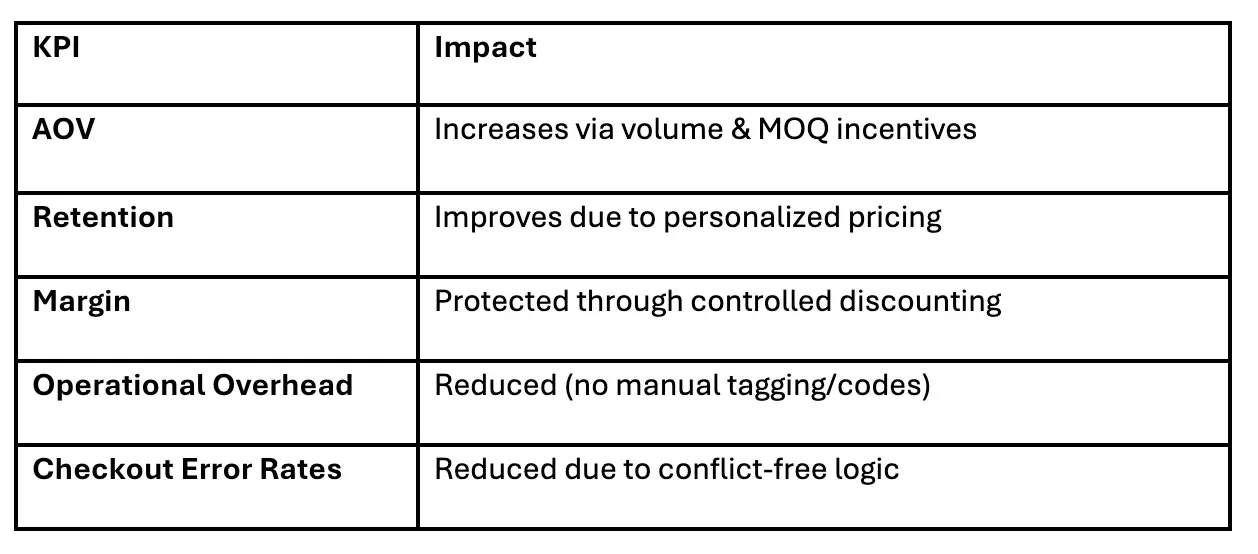
This is what modern commerce demands.
7. A Modern Solution: Shopify Native, Segment-Aware, Campaign-Based Discounting
The final piece is execution.
You need discounting that is:
- Segment-aware
- Campaign-structured
- Non-stacking & conflict-free
- Shopify-native
- Fast to set up
- Composable with ongoing + seasonal needs
The traditional approach using:
- Discount codes
- Manual tagging
- Theme scripts
- Multiple stacked apps
…was never designed for that world.
Final Thoughts
Customer segmentation answers who should get a discount. Campaign-based discounting answers when and how.
Together they create:
- Predictable pricing
- Higher margin control
- Better customer experience
- Cleaner operations
- Scalable holiday planning
This is the direction Shopify commerce is moving — especially as merchants adopt hybrid B2B + B2C models, wholesale catalogs, VIP tiers, and seasonal sales cycles.
If you’re still running flat, universal discounts without segmentation, you’re leaving both money and loyalty on the table.
Watch how Campaign-based discounting with DiscountWisp solves these issues by treating all discounts as structured, schedulable campaigns instead of isolated price hacks.
Video Link: https://www.youtube.com/watch?v=GeYWs4n8kUQ
Want to Go Deeper?
If you want to see how segmentation + campaign-based discounting works natively inside Shopify (no scripts, no hacks), check out DiscountWisp:
Start free trial now: https://apps.shopify.com/discountwisp
Explore more: https://discountwisp.com
#CustomerSegmentation #CampaignBasedDiscounting #PricingAutomation #ShopifyDiscounts #ShopifyApps #EcommerceStrategy #B2BCommerce #B2CRetail #WholesalePricing #TieredPricing #SmartDiscounting #CustomerTiers #DynamicPricing #RetentionMarketing #IncreaseAOV #MarginControl #ShopifyFunctions